
The Minimum Ethical Cage Size for Hamsters Explained

Updated: Aug 10
One of the biggest misconceptions in hamster care is how much space a hamster actually needs. Walk into many pet shops and you'll find small, brightly coloured cages marketed specifically for hamsters. Unfortunately, many of these enclosures are far too small to meet a hamster's physical and behavioural needs.
Hamsters may be small animals, but they are incredibly active. In the wild, they travel long distances each night, spend hours digging extensive burrow systems and constantly search for food. While we can't replicate the wild completely, we can provide enough space for them to express these natural behaviours.
This guide explains what an ethical hamster enclosure looks like, why size matters, and why choosing the biggest enclosure you can reasonably provide is one of the best decisions you can make for your hamster.
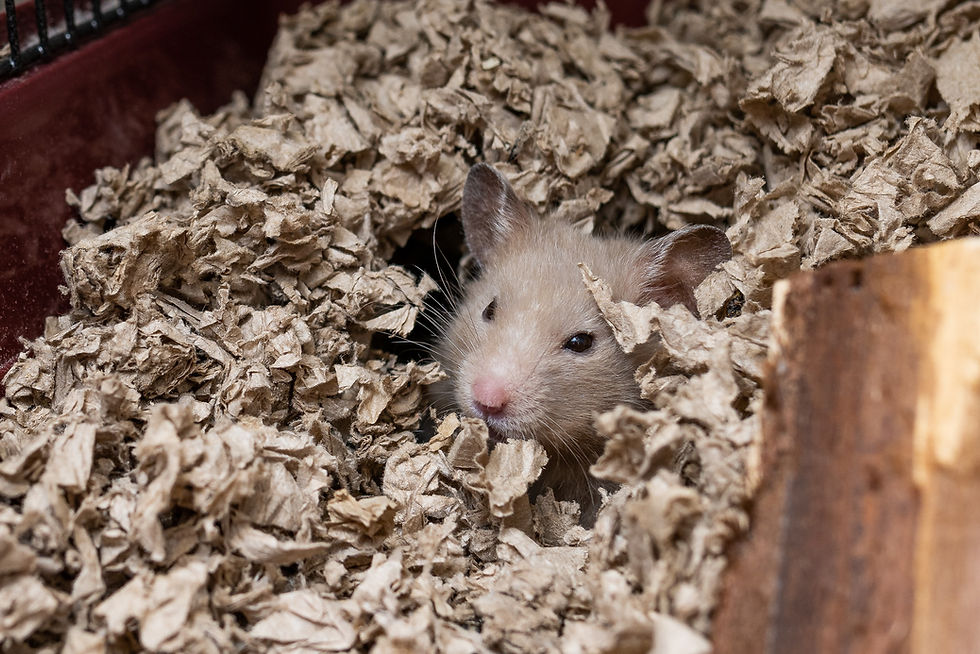
Key takeaway: There is no realistic maximum cage size for a healthy hamster. If the enclosure is safe and enriched, bigger is almost always better.
Contents
Why Cage Size Matters
What Is the Minimum Ethical Cage Size?
Why Bigger Is Better
Why Many Pet Shop Cages Are Too Small
What Makes a Good Hamster Enclosure?
Cage Size Myths
Frequently Asked Questions
Why Cage Size Matters
A hamster's enclosure is its entire world. Everything it needs—food, water, exercise, sleep, digging and exploration—must fit within that space.
When an enclosure is too small, it can prevent a hamster from carrying out natural behaviours, which may lead to stress and frustration.
A suitably sized enclosure allows your hamster to:
Burrow deeply
Run naturally
Forage for food
Explore different areas
Create separate sleeping and toileting spaces
Feel secure with multiple hiding places
Space is not a luxury—it is one of the foundations of good hamster welfare.
What Is the Minimum Ethical Cage Size?
At Bellamy Pet Wellness, we recommend an enclosure with a minimum continuous floor space of 100 × 50 cm (5,000 cm²) for all hamster species.
This is considered the minimum ethical starting point, not the ideal.
If you have the room and budget, larger enclosures are strongly encouraged.
An enclosure larger than the minimum gives you more flexibility to include:
Deeper bedding
A larger wheel
More hides
Natural enrichment
Different substrates
More opportunities for exploration
For Syrian hamsters in particular, many owners find that significantly larger enclosures better meet their behavioural needs.
Why Bigger Is Better
Unlike many myths suggest, hamsters do not become "lost" or "overwhelmed" in large enclosures.
In fact, research and owner experience consistently show that larger, well-designed habitats often lead to:
Increased exploration
More natural foraging
Better burrowing behaviour
Reduced stress-related behaviours
Greater confidence
The key is enrichment, not simply empty space.
A large, empty enclosure can feel exposed, while a large enclosure filled with hides, tunnels, bedding and natural features gives your hamster plenty of opportunities to feel safe and active.
Why Many Pet Shop Cages Are Too Small
Many commercially available cages are designed to appeal to people rather than meet a hamster's needs.
Common problems include:
Very limited floor space
Shallow bases that can't hold deep bedding
Tiny wheels that force the hamster's back to bend
Minimal room for enrichment
Too many plastic tubes and platforms instead of usable floor space
Just because a product is marketed for hamsters doesn't mean it provides appropriate housing.
When choosing an enclosure, always look beyond the packaging and consider whether it allows your hamster to express natural behaviours.
What Makes a Good Hamster Enclosure?
Size is only one part of the picture.
A welfare-focused enclosure should also include:
Deep Bedding
At least 25–30 cm (10–12 inches) of compacted bedding across much of the enclosure to allow stable burrows.
A Properly Sized Wheel
Your hamster should be able to run with a completely straight back.
As a general guide:
Syrian hamsters usually need a 28–30 cm wheel
Most dwarf species need a 20–25 cm wheel
Multiple Hides
Provide several hiding places throughout the enclosure so your hamster always has somewhere to retreat.
Sand Bath
A large sand bath allows hamsters to clean their fur naturally and provides valuable enrichment.
Use only hamster-safe sand and avoid dusty products.
Enrichment
Include plenty of opportunities for natural behaviour, such as:
Cork logs
Wooden tunnels
Seed sprays
Scatter feeding
Dig boxes
Safe branches
Chew toys
The enclosure should encourage activity rather than simply contain your hamster.
Cage Size Myths
"Small hamsters need tiny cages."
False.
Even dwarf species are highly active and benefit from spacious, enriched enclosures.
"My hamster only sleeps."
Hamsters are nocturnal, meaning much of their activity happens overnight when you aren't watching.
A sleeping hamster during the day is completely normal.
"Large cages stress hamsters."
There is no good evidence that appropriately enriched large enclosures cause stress.
Poor enclosure design—not size—is the issue.
"My hamster climbs the bars because they enjoy it."
Bar climbing is often a sign that a hamster is trying to escape or is frustrated with its environment, particularly if it happens frequently.
Signs Your Enclosure May Be Too Small
Your hamster may benefit from a larger enclosure if you notice:
Persistent bar biting
Monkey barring (climbing upside down)
Repeated pacing
Excessive attempts to escape
Little room for bedding or enrichment
Constant interaction with enclosure walls
These behaviours can have multiple causes, but inadequate space is a common contributing factor.
Frequently Asked Questions
What is the minimum cage size for a hamster?
We recommend 100 × 50 cm (5,000 cm²) of continuous floor space as the minimum ethical starting point, with larger enclosures encouraged whenever possible.
Is there a maximum cage size?
No. As long as the enclosure is safe, secure and well enriched, larger is generally better.
Do dwarf hamsters need less space than Syrian hamsters?
Although accessories differ in size, both species benefit from large enclosures that allow natural behaviours.
Are plastic hamster cages suitable?
Some can be suitable if they provide enough continuous floor space, deep bedding and good ventilation. Many, however, are too small.
Are barred cages or glass tanks better?
Both can work well if they provide sufficient floor space, adequate ventilation and allow deep bedding. The overall size and setup matter far more than the material.
Final Thoughts
Choosing the right enclosure is one of the most important decisions you'll make as a hamster owner. While many cages sold in shops are marketed as suitable, true welfare goes beyond the label.
A spacious enclosure with deep bedding, natural enrichment and room to explore allows your hamster to express the behaviours that make them healthy and happy. Rather than aiming for the smallest cage that meets a number, aim for the largest enclosure you can realistically provide.
At Bellamy Pet Wellness, we believe ethical hamster care starts with giving every hamster enough space to thrive—not just survive.
Visit our Amazon Storefront for a wide selection of hamster products and great value essentials for your pets!
Related Content
https://www.bellamypetwellness.com/post/natural-hamster-enclosure-guide https://www.bellamypetwellness.com/post/unsafe-hamster-products-i-d-never-buy-and-what-to-choose-instead
https://www.bellamypetwellness.com/post/what-to-buy-before-getting-a-hamster https://www.bellamypetwellness.com/post/9-common-hamster-owner-mistakes-and-how-to-fix-them
Disclaimer
All content provided on this website, including blog posts, guides, social media content, and recommendations, is created for informational and educational purposes only and should not be considered veterinary, medical, or professional pet care advice. Always consult a qualified veterinarian or animal care professional before making decisions regarding your pet’s health, diet, or wellbeing. See Full T&C's here.


Comments